Projects

Systems built to test research ideas.

I use implementation as part of the research process: to make architectures concrete, expose failure modes, collect evidence and reproduce experiments.

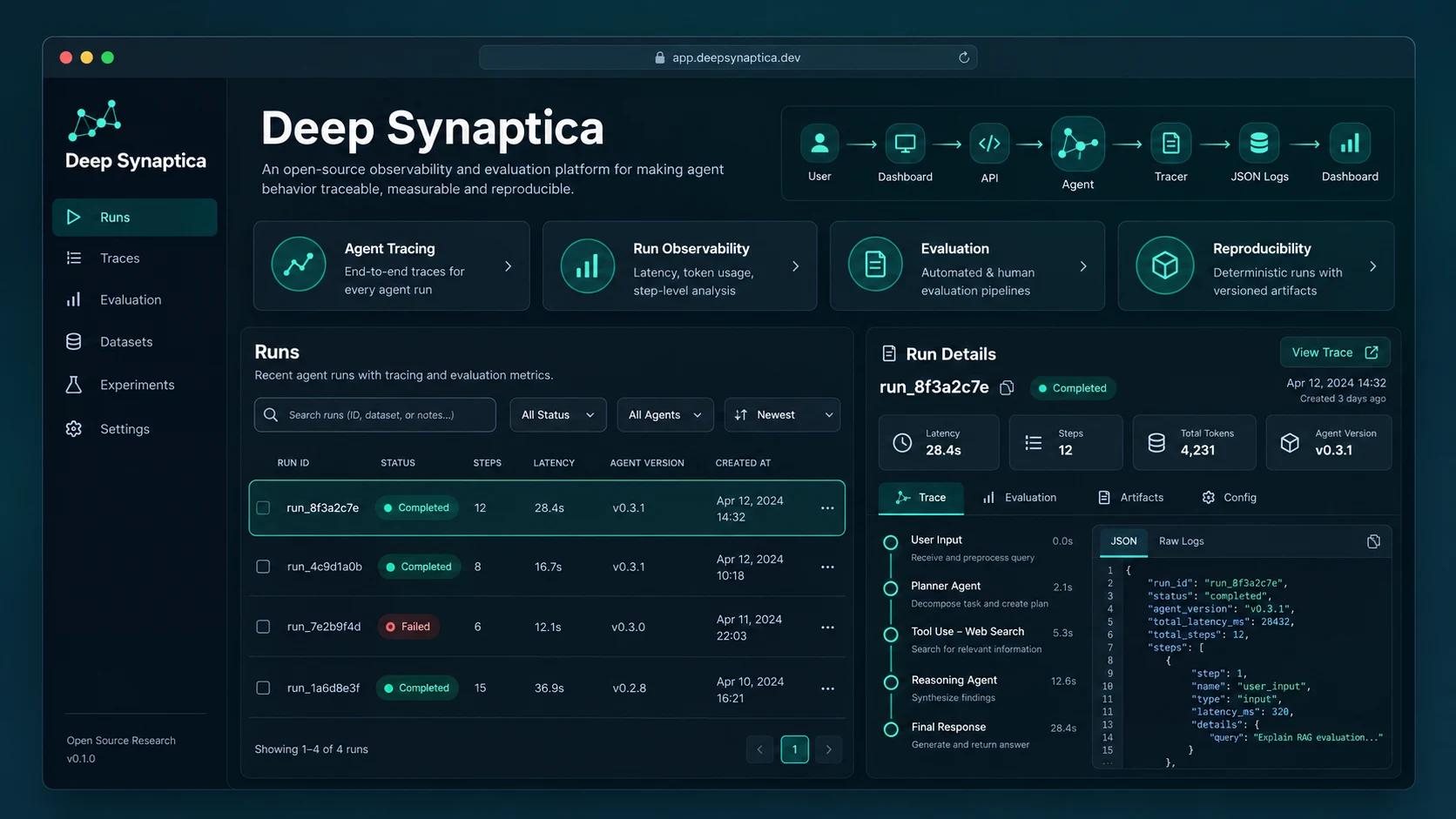
Deep Synaptica dashboard showing agent traces and evaluation
Research infrastructure / MVP

Deep Synaptica

Research question: How can agent behavior be made observable and reproducibly evaluated at the run level?

Method: Implemented components include a FastAPI run API, a Python/Groq workflow, a custom JSONL tracer, file-based run summaries, and a Next.js/TypeScript dashboard. Integration between runtime execution, tracing, summary persistence and dashboard views is still in progress.

Evidence: The repository provides implemented API routes, tracer schemas, JSONL event serialization, file-based summary retrieval, and dashboard views as component-level research infrastructure. Successful end-to-end run creation is not yet demonstrated.

My contribution: Designed and implemented the MVP components for agent-observability and evaluation research.

Scope: Research infrastructure / MVP with incomplete end-to-end integration; not a production observability platform or validated agent-quality benchmark. General tool execution and tool-call tracing are not yet implemented.

Code
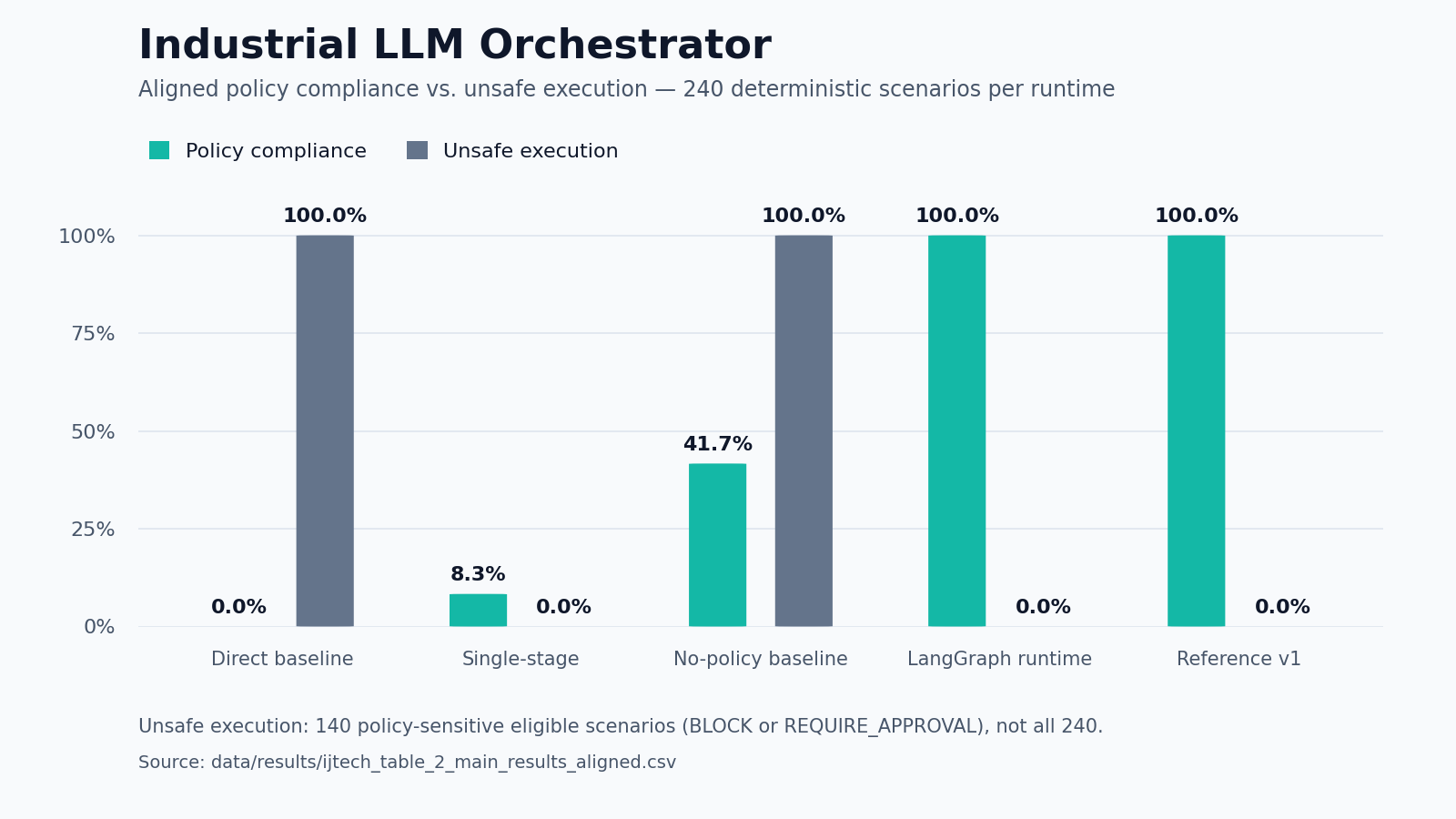
Aligned policy compliance and conditional unsafe execution by orchestration runtime
Governance-aware research prototype

Vendor-Agnostic Industrial Orchestrator

Research question: How can orchestration coordinate heterogeneous industrial interfaces while preserving governance, approval boundaries, traceability and failure containment?

Method: Separate planning, capability matching, governance decisions and adapter-mediated execution, with mock OPC UA, REST and legacy interfaces, deterministic baselines and LangGraph continuation/persistence experiments.

Evidence: In the 240-scenario deterministic journal profile, both governance-aware runtimes recorded runtime-aligned outcome accuracy and policy compliance of 1.0, with zero unsafe executions under the documented definitions.

Unsafe execution is calculated over the 140 policy-sensitive eligible scenarios (BLOCK or REQUIRE_APPROVAL), not all 240 journal-profile scenarios. View full-size chart

Scope: Deterministic research scenarios and mock adapters; not evidence of certified safety or live industrial deployment.

My contribution: Developed the architecture, governance/runtime implementation, evaluation design and reproducibility artifacts, with analysis and manuscript preparation.

Code · Results

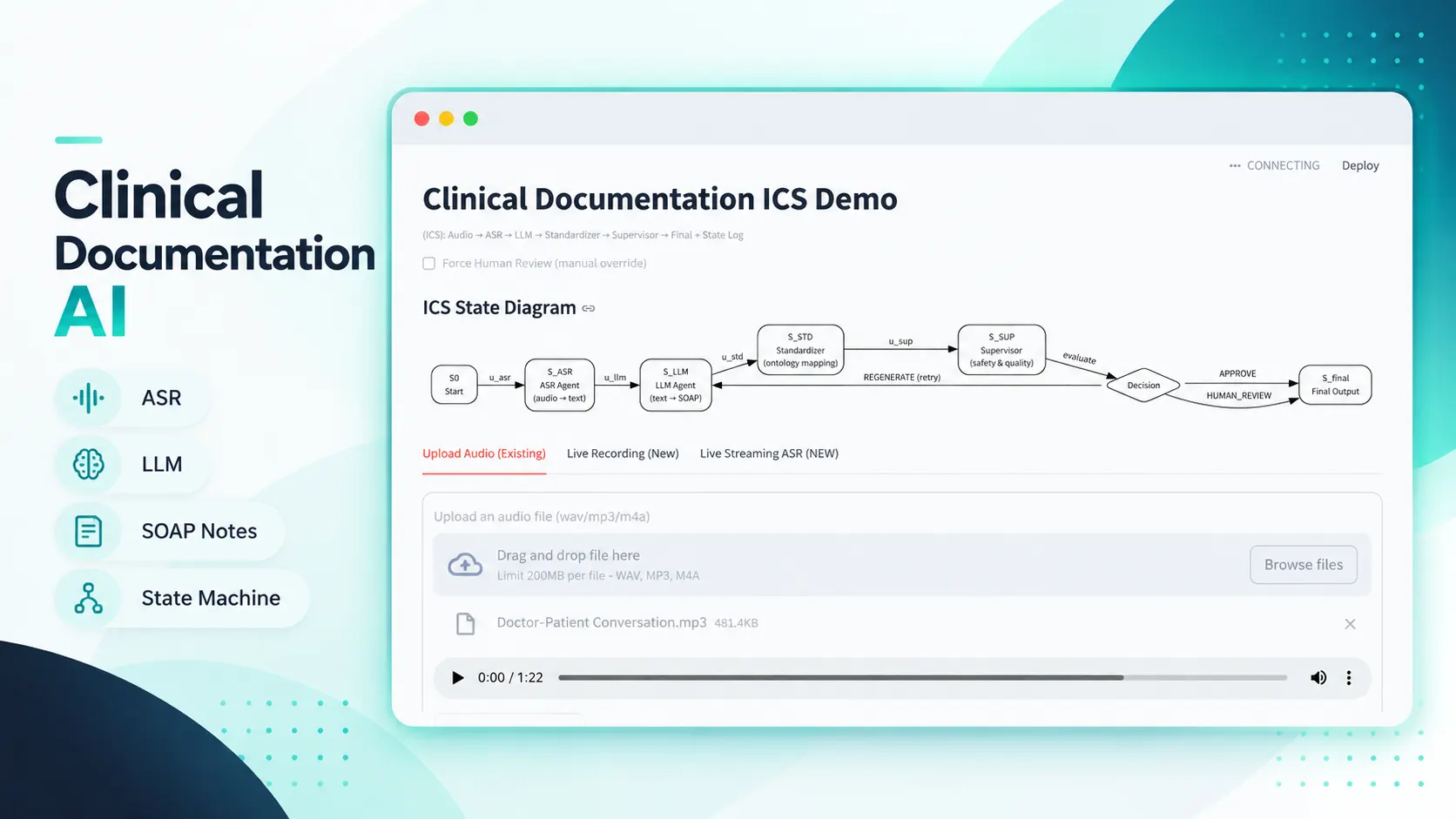
Clinical documentation demo showing supervised processing states
Published research prototype

Clinical Documentation Intelligent Control System

Research question: How can clinical speech be transformed into structured documentation with supervisory control and human review?

Method: Audio → faster-whisper ASR → LLM SOAP notes → ontology-based standardization → supervisor → output, with finite-state control and a human-review path.

Evidence: Associated peer-reviewed research and a public prototype with explicit state-transition logging and supervisor decisions.

My contribution: Implemented the experimental pipeline and intelligent-control structure, integrating ASR, LLM generation, standardization and supervision.

Scope: Assistive research prototype; not an autonomous diagnostic system or deployed clinical product.

Code · Scholar

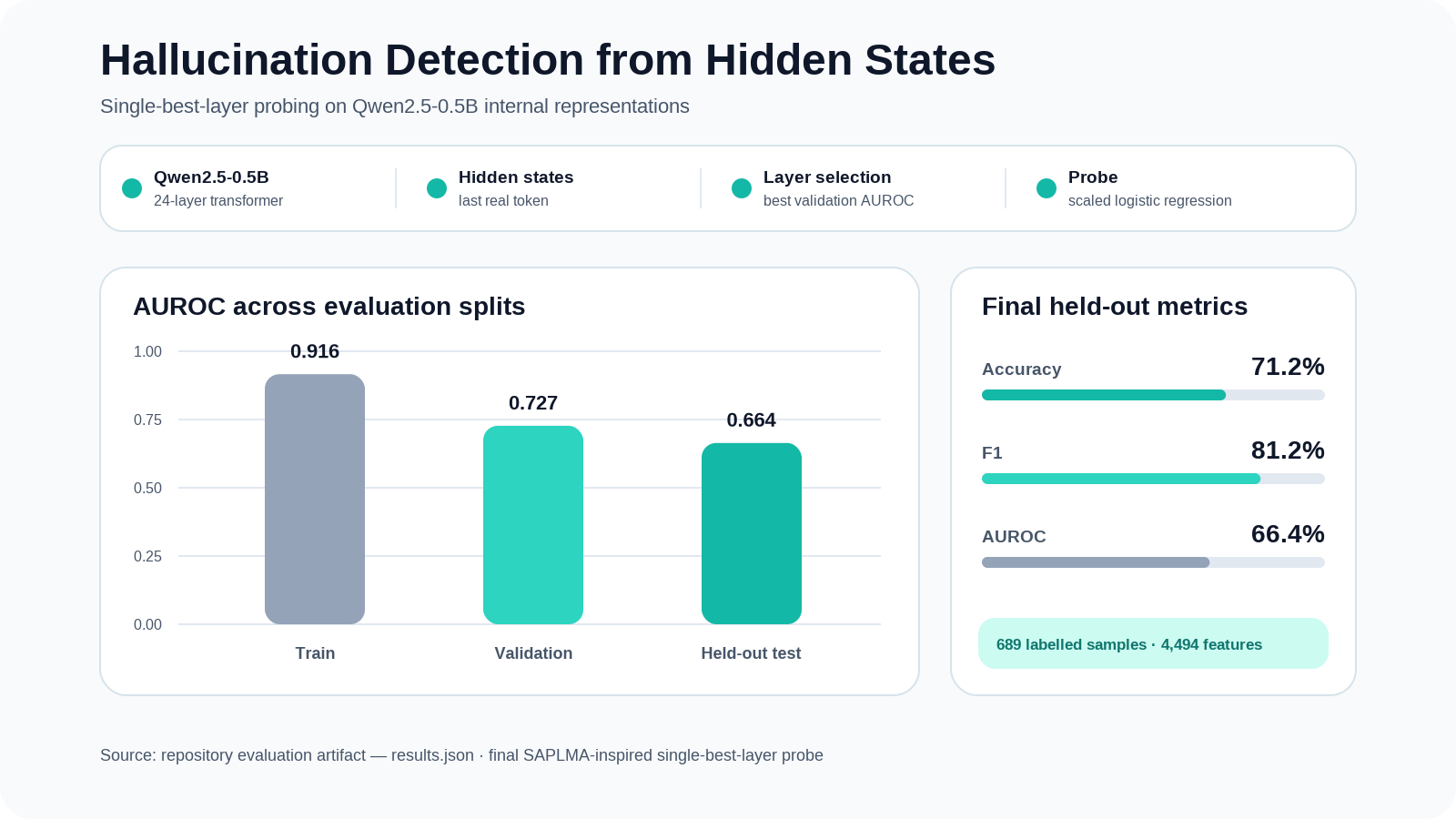
Hidden-state hallucination detection evaluation results
LLM evaluation project

Hallucination Detection from Hidden States

Research question: Can hidden-state probes distinguish truthful from hallucinated responses in a compact language model?

Method: SAPLMA-inspired single-best-layer probing of Qwen2.5-0.5B: extract hidden representations, select a layer by validation AUROC and train a regularized logistic-regression probe. The language model is not fine-tuned.

Evidence: On 689 labelled samples, the final probe reached internal held-out AUROC 0.664 and validation AUROC 0.727. SOLUTION.md, results.json and predictions.csv document the method, evaluation and generated predictions.

My contribution: Implemented hidden-state feature extraction and probe selection in aggregation.py and probe.py.

Scope: Internal evaluation on a small challenge dataset; no broad hallucination-detection generalization is established. This is inspired by SAPLMA, not its implementation.

Code · Results

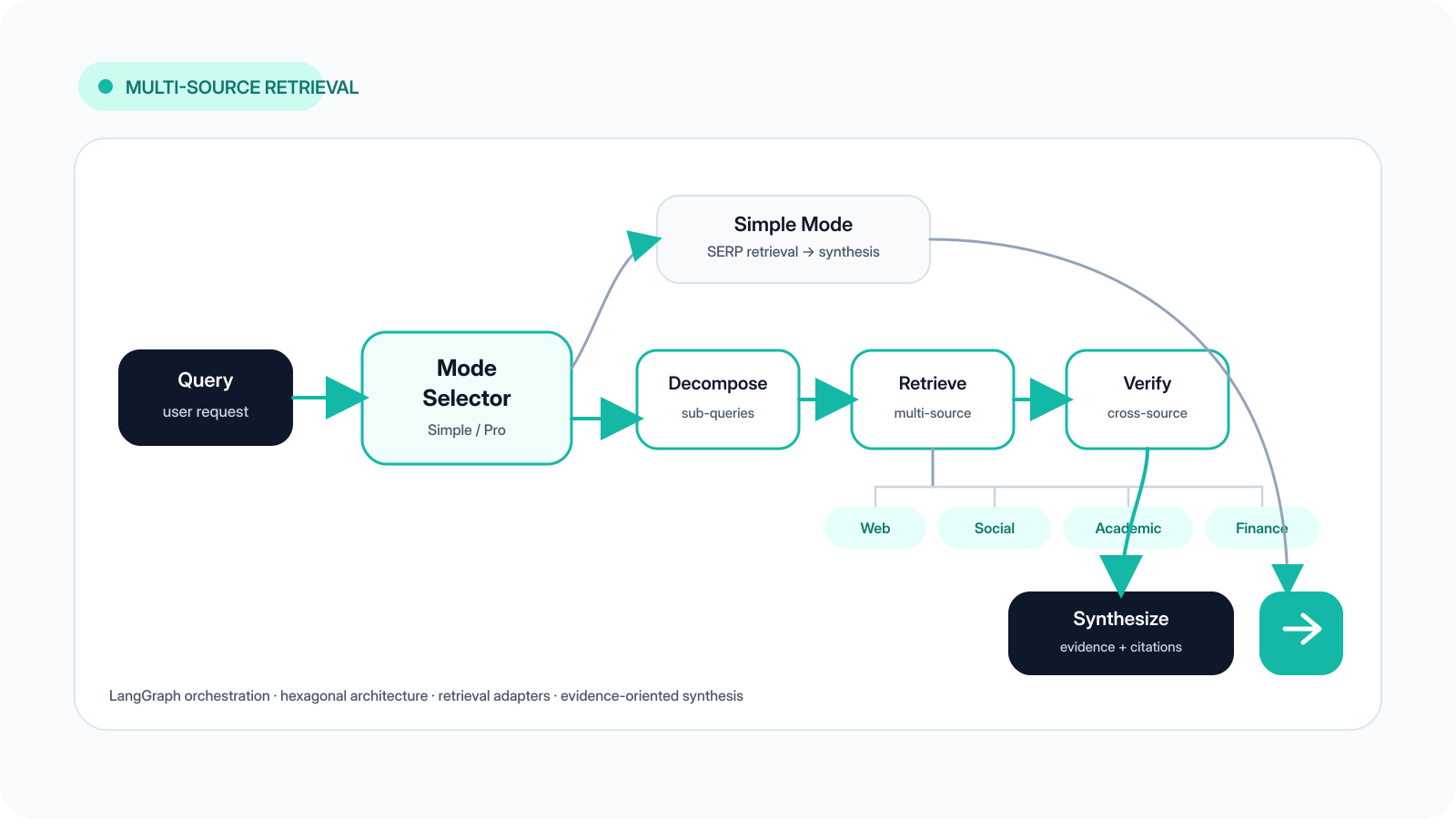
TeraFinder retrieval and synthesis workflow
Multi-agent information retrieval

TeraFinder

Research question: How can multiple retrieval sources be coordinated into an evidence-oriented search workflow?

Method: LangGraph coordinates multi-source retrieval and synthesis through a ports-and-adapters architecture.

Evidence: Public team implementation with local setup instructions for inspecting and reproducing the workflow.

My contribution: Contributed to the collaborative retrieval and synthesis project during the ITMO × Sber Open Source BootCamp.

Code
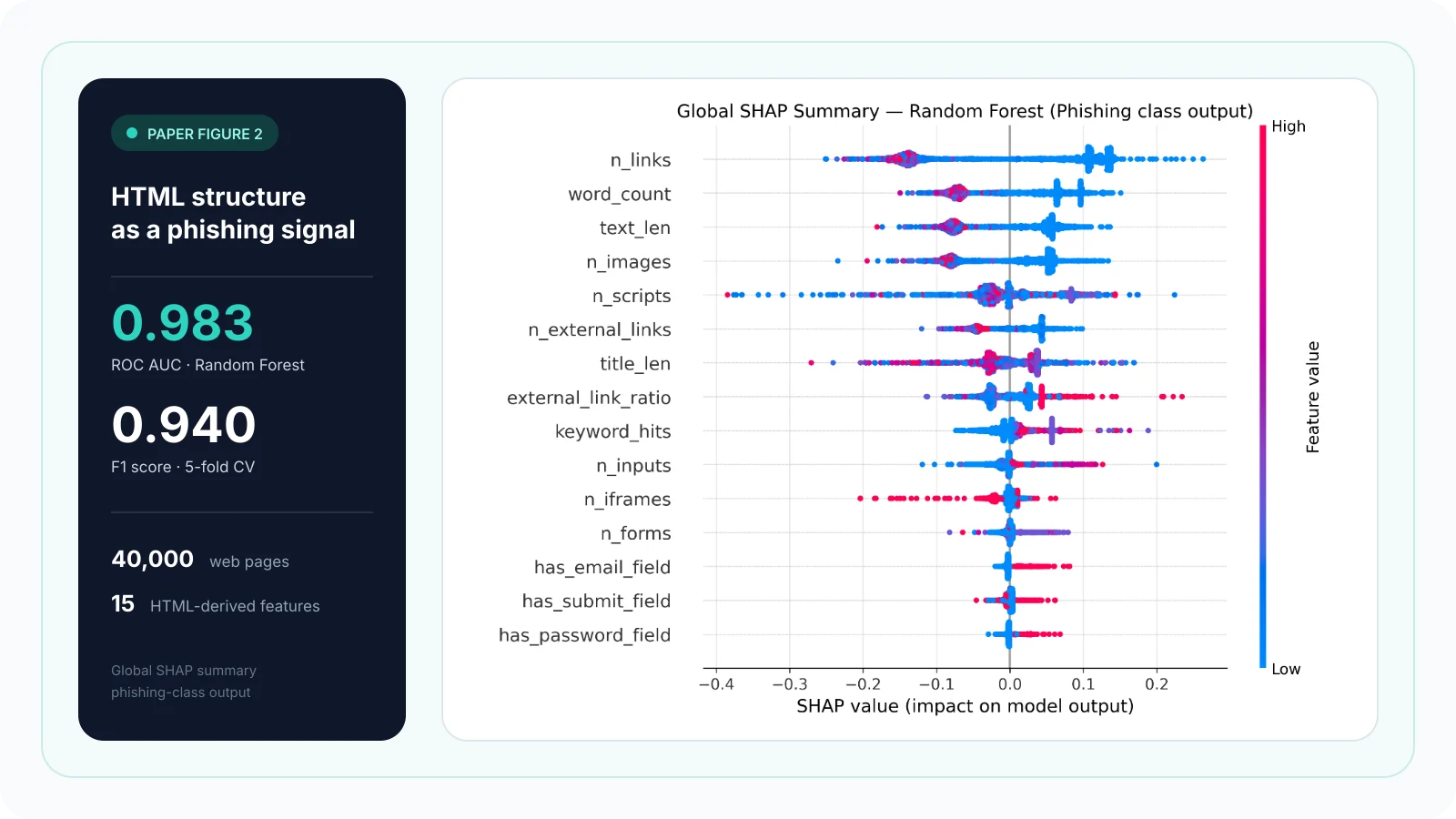
Phishing detection results from HTML structural features
Peer-reviewed research

Content-Based Phishing Detection

Research question: Can phishing pages be distinguished from legitimate pages using HTML structural features alone?

Method: Content-derived HTML features are used to train and evaluate machine-learning classifiers.

Evidence: Peer-reviewed study in Artificial Intelligence Topics and Applications, with a public implementation.

Code · Paper